### My “Kitchen Philosophy”
#### General introductory remarks
In this autobiographical-philosophical essay series I write about my everyday philosophy.
Several years ago – already in retirement – I toyed with the idea of studying philosophy at university. In a conversation about the meaning of philosophy a doctor of philosophy told me that my philosophical ideas could be described as “kitchen philosophy”. I apparently had completely different notions of the philosophy taught at universities.
#### Philosophy of resilience and practical art of living
I occupied myself autodidactically and in conversations with a PhD in philosophy with modern academic philosophy. However, its approaches could not convince me.
For me philosophy is not a purely theoretical academic science, but a compass for everyday life and a tool for coping with life. Precisely this was dismissed by the academic side as “kitchen philosophy”.
In my view, however, philosophy belongs exactly where people can actually do something with it – in the kitchen, on the marketplace or in everyday life – and not only in the ivory tower of the university.
It should serve as a practical support for living. Instead of abstract theories I see it as a tool for crisis management and mental strengthening. A central pillar of my work is therefore the curation of wisdom: I have collected more than 2,000 quotations with core ideas from worldwide philosophical and spiritual currents that have a direct everyday reference.
That is why there is no theoretical-academic treatise here, but a practice-oriented overview. My focus is on short, condensed quotations by thinkers who have put the essential things in a nutshell. These quotations have proven themselves over the last 17 years and have helped many people who saw and liked them on my high-reach X account.
My call is: Back to the origins and out of the ivory tower of philosophy! What use is the most profound treatise on epistemology if no ordinary person understands it and it helps no one in everyday life?
My “kitchen philosophy” makes no claim to general validity. Like every genuine science it should be examined and questioned. I am open to criticism – justified objections should be taken into account. A science that does not allow doubt is no longer a science.
The condensed quotations can serve as food for thought. They are not suitable for dealing with physical or psychological illnesses. In such cases a doctor or psychiatrist must be consulted.
Encouraging sayings by possibility thinkers or success coaches can also suggest chances of success that do not always materialise. Optimistic words are meant to give courage – guarantees, however, do not exist.
#### The ancient tradition
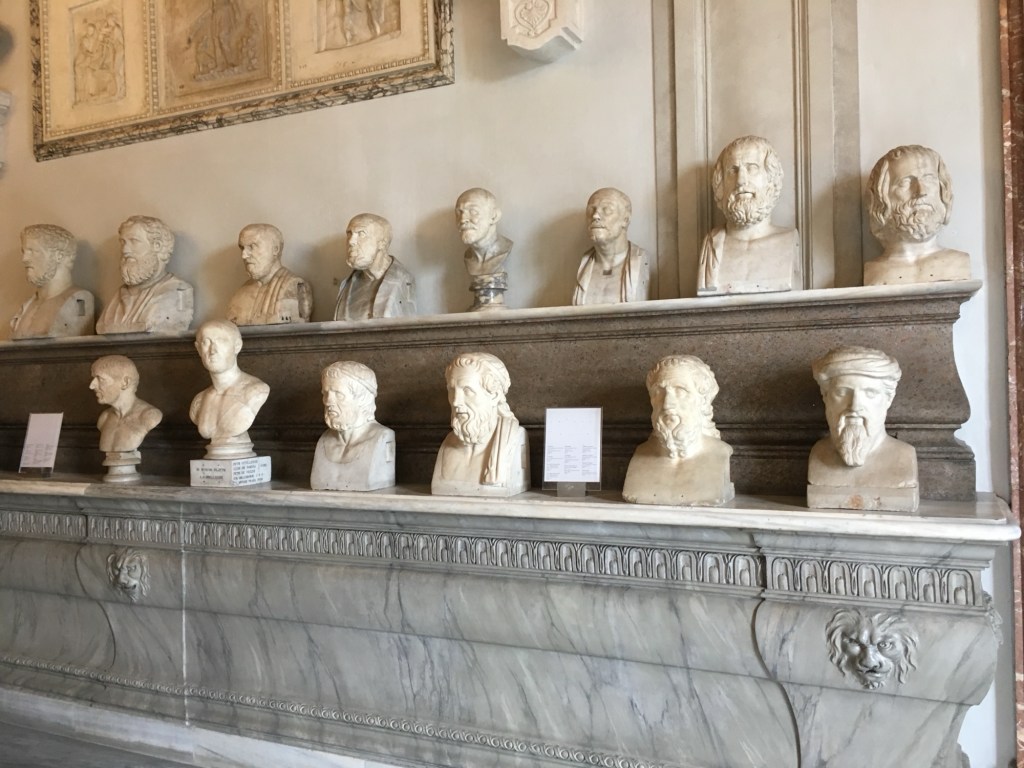
The original philosophers such as Socrates did not sit in sterile university offices. They stood in the marketplace and spoke with people about their real lives. Socrates’ philosophy was kitchen philosophy in the best sense because it was close to people.
Epictetus, Seneca and Marcus Aurelius also formulated solid, simple rules for everyday life. Independent thinkers argue that they continue the actual tradition of philosophy, while modern universities have often lost themselves in bureaucratic language games.
In the following I give only a brief overview of the most important philosophies that have influenced my contributions. A deeper scientific insight is neither intended nor purposeful here. What matters to me are principles and tools that can be useful in daily life.
Brief overview of the most important philosophies
**Stoicism**
The philosophy of Stoicism can be summarised in one core sentence:
**True serenity and happiness arise when we learn to accept what cannot be changed and to control only what is within our own power.**
The Stoics divided their teaching into three areas:
1. **Stoic ethics (way of life)**
– Dichotomy of control: Strictly distinguish between what you can influence (thoughts, actions, reactions) and what lies outside your power (weather, actions of others, fate).
– Ataraxia (peace of mind): By accepting the unchangeable one achieves emotional independence.
– The four cardinal virtues: wisdom, courage, justice and moderation.
2. **Physics (world view)**
– Cosmic reason (Logos): The world is an ordered, rational whole.
– Fate (Amor Fati): Everything happens for a reason. Man should not only endure his fate but actively accept and love it.
3. **Logic (theory of knowledge)**
– Emotions do not arise from events themselves but from our evaluation of those events.
– Through logical examination of one’s own impressions destructive fears and drives can be switched off.
**Eastern philosophy**
Far-Eastern philosophies are essentially paths of life (Do/Tao). They seek harmony with the cosmos instead of wanting to dominate nature or fate.
1. **Daoism (Laozi) – The way of nature**
– The Dao: the intangible primal force of the universe.
– Wu Wei (non-forcing): acting through non-action – flowing with the current of life instead of fighting against it.
– Yin and Yang: harmony arises through the balance of opposites.
2. **Buddhism (Siddhartha Gautama) – The liberation of the mind**
– The Four Noble Truths: Life is marked by suffering; the cause is craving; suffering ends when craving ceases.
– The Noble Eightfold Path: right thinking, meditation and ethical action.
– Nirvana: the extinction of suffering and absolute peace of mind.
3. **Confucianism (Confucius) – Social order**
– Focus on the here and now, society and the state.
– Deep respect for parents, ancestors and social hierarchies.
– Humaneness (Ren) and the Golden Rule: “What you do not wish for yourself, do not do to others.”
**Christian philosophy**
Christian philosophy combines biblical faith with the tools of ancient logic. Its core sentence is:
**God is absolute truth and love; man finds his fulfilment in the relationship with his Creator.**
Central pillars (shaped among others by Augustine and Thomas Aquinas):
1. **Image of God and creation**
– Creation out of nothing (Creatio ex nihilo).
– God as the highest being (Summum Bonum).
– Evil is not an independent principle but the lack of good, caused by the misuse of free will.
2. **Man and redemption**
– Image of God (Imago Dei): every human being possesses inviolable dignity.
– Free will and divine grace.
– Love of neighbour and enemy as the highest ethical commandment.
3. **Faith and reason**
– Faith (Fides) and reason (Ratio) do not contradict each other.
– “Credo ut intelligam” (Augustine): believe in order to understand.
Because the various philosophies do not fit together seamlessly, I have remained with Christian teaching. That does not mean, however, that one may not respectfully perceive and use insights from other philosophies.
#### Healing a crisis and the role of everyday philosophy
In my view academic philosophy has a relevance crisis because to a not inconsiderable extent it only still writes for itself. The return to simple, practical truths is an attempt to give philosophy back its actual soul.
My essays often revolve around how one finds inner strength and clarity in a restless world. In doing so I draw on approaches of ancient Stoicism and existential questions.
Philosophising is for me not pure study of old texts but an active, daily process of questioning one’s own existence.
**My philosophy is a philosophy of life and not medical psychotherapy.**
– I give no promise of healing and make no diagnoses.
– My contributions are prevention and mental accompaniment for healthy people in difficult life situations.
– In the case of genuine mental illnesses evidence-based medical and psychiatric treatment is required.
What I describe here and on X is in the best sense a modern form of pastoral care or mental coaching: strengthening the “mental immune system” in everyday life and giving food for thought – with full personal responsibility of the reader.
#### Life stations – My odyssey
The religion of my ancestors is Roman Catholic and Lutheran Protestant. As a Catholic I was an active layman in the Church for decades.
I initially briefly considered studying Catholic theology but refrained because of the tight binding to the prescribed teaching. In addition to my business studies I studied some Protestant theology out of interest. The repeated intensive working through of the Bible (Unity Translation and Luther Bible) at the beginning of the 1970s belongs to my most important life stages.
Besides Christian teaching I was also interested in the wisdoms of other religions and philosophies. I possess an extensive collection of philosophical works.
– In 2009 I engaged with the teaching of the Rosicrucians.
– In 2010 I began reading Buddhist writings (among others the Harvard lectures of the Dalai Lama, the Tibetan Book of Living and Dying, the Tibetan Book of the Dead).
– In 2020 I read the Hindu Bhagavad Gita.
– The insights of Eckhart Tolle and Dale Carnegie were also important to me.
In my studies of philosophy I repeatedly encountered difficulties: my idea that philosophy should serve as a tool for good living did not fit the modern academic approaches. That is why I deliberately refrained from a university study and continued my education autodidactically.
#### Curated wisdom – Everyday philosophy here and on X
My philosophy is not limited to thinking alone. Under the guiding idea “Success is useless if we become ill as a result” I directly combine mental art of living with physical health (exercise and raw-food nutrition).
The wisdoms I share free of charge compress complex truths into sentences that immediately address heart and mind. Timeless wisdoms are not dusty doctrines but living tools that raise the ethical level and in extreme cases can even save lives.
A central pillar of my work is collecting and sharing more than 2,000 uplifting quotations. In doing so I combine core ideas from:
– **Ancient Stoicism** (Seneca): focus on what can be controlled and overcoming fears.
– **Eastern wisdom** (Buddha, Laozi, Confucius): mindfulness and inner peace.
– **German Classicism** (Goethe): courage, energy and tireless striving.
The Stoics teach that we often cannot control external circumstances, but we can control our reaction to them.
Humanism places the dignity of every single human being at the centre and demands neighbourly love and civil courage.
The Enlightenment calls on man to use his own reason and to emerge from immaturity.
My philosophy is therefore not something I invented myself but a synthesis of Christian ethics, Buddhist and Hindu wisdoms, Greek philosophy, humanism and the Enlightenment.
As a high-reach actor in the digital space I consciously use my X account @SunnyRainer to bring philosophical impulses from the university ivory tower directly into the everyday life of more than 200,000 subscribers.
#### Closing remarks
At the age of nine (1962) I had a near-death experience during an operation at Aachen Clinic. I was pulled through a tunnel with luminous colours; at the end there was a bright light and a feeling of complete peace. A bright figure said to me: “You still have tasks to fulfil! You must go back!”
When my mother later showed me a family album I recognised in my grandfather Erich Schulz (who had died 19 years before my birth) the figure from this experience.
Since the beginning of the 1970s I have firmly built the emptying of the mind, listening to the Holy Spirit and daily gratitude into my daily routine.
Among all the denominations, religions and philosophies that I have explored over 60 years, my Christian faith remains central for me.
I am a Christian, but I bow before the wisdom of the Buddha and learn from him how to discipline my mind in order to become a better Christian and a better human being.
Christianity, philosophy and the Enlightenment are for me not contradictions but three sides of the same coin. All of them call me not only to believe or to think, but to act well.
**There is nothing good unless you do it.**
That remains my guiding star.
 Rainer Seiffert's Blog