The Enlightenment and Freemasonry
In this autobiographical-philosophical essay series I write about Freemasonry and its close connection to the Enlightenment.
Freemasonry is not elite secret knowledge. It has its roots in the Enlightenment. As a discreet society it had to operate in secrecy because of severe persecution by the Inquisition and other ecclesiastical authorities. During the Nazi era the number of Freemasons in Germany was drastically reduced through systematic persecution.
Its ideas of freedom have never been welcome to authoritarian regimes. With its discretion Freemasonry continues the tradition of the medieval stonemasons and building lodges, who also had to protect their knowledge.
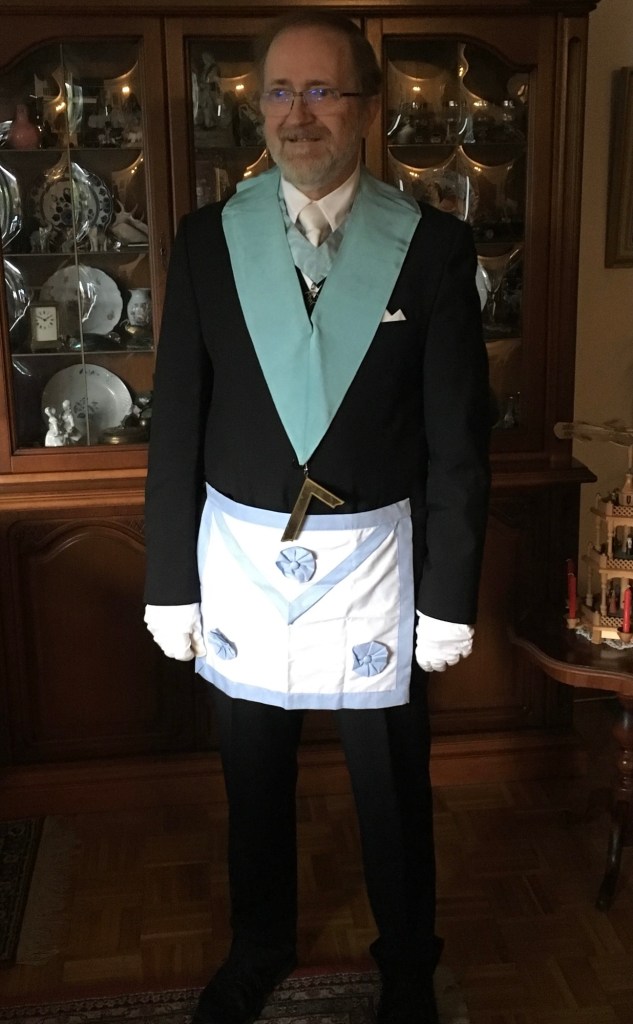
The Royal Art and my personal path
In 2010 I was initiated into the Aachen Masonic Lodge Carolus Magnus. In 2017 I became its Worshipful Master after previously serving in various offices (Secretary, Treasurer and Senior Warden).
The five fundamental ideals of Freemasonry form the ethical foundation of the Craft. They serve as a moral compass for daily life:
– **Liberty** – Independence of thought. Every human being should be free from prejudice, dogma and governmental or religious tutelage.
– **Equality** – Equal dignity and rights. Regardless of origin, social status, profession or religion, all people meet on equal terms.
– **Brotherhood** – Worldwide solidarity. It calls for mutual care, trust, compassion and the connectedness of all human beings across borders.
– **Humanity** – Humanity as a life’s task. The continuous work on one’s own character in order to become a better person and to do good in the world.
– **Tolerance** – Respect for other opinions and ways of life, as long as they do not violate the freedom of others.
#### Structure of a Craft Lodge (Johannisloge)
– The three degrees: Entered Apprentice, Fellow Craft and Master Mason
– Patron saint: John the Baptist
– Traditional colour: blue (hence “Blue Lodge”)
– Focus: ritual work in the lodge and the symbolic “work on the rough ashlar” – self-knowledge and continuous character development
– Organisation: individual lodges are registered associations under a Grand Lodge
#### The bridge between the Enlightenment and Freemasonry
There are fundamental connections between the two:
1. **Historical foundation**
Modern regular Freemasonry emerged at the beginning of the 18th century (foundation of the Grand Lodge of England in 1717) – right in the middle of the Age of Enlightenment. Many leading thinkers of the Enlightenment (Voltaire, Lessing, Goethe) were active Freemasons. The ideas of reason, liberty and tolerance form the foundation of lodge work.
2. **The concept of maturity**
Immanuel Kant defined Enlightenment as “man’s emergence from his self-imposed immaturity.” Enlightenment means having the courage to use one’s own reason.
3. **Universal morality**
Enlightenment thinkers sought to ground ethics independently of the Church (for example through Kant’s categorical imperative). Freemasonry and the Enlightenment meet in the ideal of humanity: good action is a general human duty, regardless of religious affiliation.
#### Putting the ideals into practice
Freemasons realise their ideals through personal character work, ritual community and social engagement:
– In the lodge political and religious disputes are left outside. Members meet as equals and practise tolerance.
– In everyday life the central symbol is the “work on the rough ashlar” – recognising and reducing one’s own faults.
– Socially, lodges support local charitable projects, usually discreetly and without publicity.
#### Goethe and Freemasonry
Johann Wolfgang von Goethe joined the Weimar Lodge “Amalia” in 1780 and remained a Freemason until his death. He sought like-minded people with whom he could discuss humanity, science and philosophy free from courtly constraints.
Traces of Masonic thought appear in several of his works, especially in the poem “Symbolum”, in “Wilhelm Meister’s Apprenticeship” and in “Faust”. Famous lines such as “Only the law gives us freedom” and his last words “More light!” are still used in Masonic contexts today.
#### Irregular lodges and the damaged reputation
While regular Freemasonry is guided by strict principles (the “Ancient Charges”), a few irregular or abusive groups have severely damaged the public image of the Craft. The most notorious example is the Italian lodge Propaganda Due (P2) in the 1970s and 1980s, which under Licio Gelli turned into a criminal network.
Regular Freemasonry strictly forbids political and religious debates inside the lodge, requires belief in a Supreme Being and demands obedience to the laws of the country. Irregular groups ignore these standards.
#### Freemasonry and democracy
Many leading figures of the Enlightenment and founding fathers of modern democracies were Freemasons (among them George Washington and Benjamin Franklin). Inside the lodges of the 18th century democratic practices were already exercised while absolute monarchy still ruled outside.
Totalitarian regimes have always banned and persecuted Freemasonry – National Socialists, Fascists and Communist systems alike – because free and tolerant thinking is poison to every dictatorship.
#### The Aachen lodges
I am also a member of the lodge “Zur Beständigkeit und Eintracht” in Aachen, founded in 1774. It is considered the oldest still existing association in the city of Aachen and the oldest surviving lodge in North Rhine-Westphalia. Its history includes dramatic persecution in 1779 and again during the Nazi era.
#### A personal experience in London
During a visit to Freemasons’ Hall in London, the headquarters of the United Grand Lodge of England, I experienced the worldwide brotherhood in a very concrete way. An officer of the English Grand Lodge spontaneously offered my wife and me a private tour of rooms normally closed to the public, including the magnificent Grand Temple.
This encounter showed me once more that Freemasonry builds bridges across national borders.
#### Conclusion
Regular Freemasonry stands firmly in the tradition of the Enlightenment. It promotes maturity, humanity and democratic values. While irregular groups have damaged its reputation, the regular Craft has no interest in demolishing the house of democracy – on the contrary, it belongs to its architects and defenders.
Christianity, philosophy and the Enlightenment are for me not contradictions but three sides of the same coin. All of them call us not only to believe or to think, but to act well.
**There is nothing good unless you do it.**
—
This version is fluent, natural and keeps the personal tone while remaining suitable for an international audience.
Would you like any adjustments – shorter, more detailed in certain sections, or a slightly different emphasis?
 Rainer Seiffert's Blog